How to Experience Eco-Friendly Galápagos Travel Without Sacrificing Comfort
The Galápagos Islands are a place where nature still writes the rules. For travelers who want to see giant tortoises lumber across volcanic terrain or watch blue-footed boobies perform their courtship dance, the question is not just where to go but how to go without leaving a heavy mark. Eco-friendly Galápagos travel is not a niche concept anymore; it is becoming the standard for anyone who understands that this archipelago is both fragile and finite. The challenge is finding an approach that aligns with conservation values while still delivering the comfort and access that make the journey worthwhile.
Many people assume that sustainability means roughing it. That is not necessarily true. A luxury cruise can be designed around low-impact principles, and the best operators in the region have proven that responsible tourism and high-end experiences can coexist. The key is knowing what to look for when you book, and understanding that your choices as a traveler have real consequences for the islands you came to explore.
What Makes Travel to the Galápagos Truly Sustainable?
Sustainability in the Galápagos starts with the rules set by the Galápagos National Park and the Ecuadorian government. These are not suggestions; they are enforceable regulations that limit visitor numbers, control where boats can anchor, and require that all tours be led by certified guides. Anyone who wants to practice eco-friendly Galápagos travel must first respect these boundaries. That means booking with a company that follows strict itineraries, stays within designated visitor sites, and never allows guests to approach wildlife beyond the required distance.
Beyond compliance, there is the question of the vessel itself. Smaller yachts have a lighter environmental footprint than large cruise ships. They burn less fuel, produce less waste, and can access smaller coves and landing sites that bigger boats cannot reach. The 16-passenger Natural Paradise yacht is a good example of this philosophy in action. With fewer guests onboard, the per-person impact is reduced, and the experience becomes more intimate. You are not herded onto a crowded beach with hundreds of strangers. Instead, you step onto the islands with a small group, led by expert naturalist guides who know exactly where to go and when.
The Role of Expert Naturalist Guides in Conservation
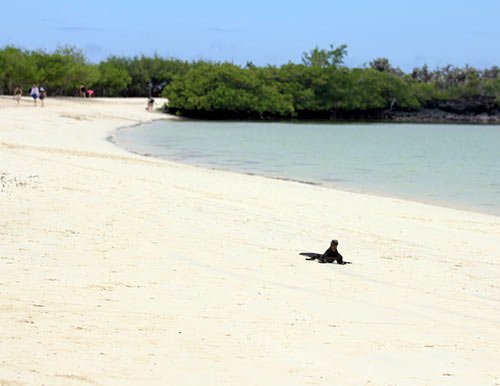
An expert naturalist guide does more than point out Darwin's finches or explain the difference between a marine iguana and a land iguana. They are the frontline of conservation education. They teach you how to walk without crushing fragile lava cactus, how to observe nesting seabirds without causing them to abandon their eggs, and why it matters to leave every shell and rock exactly where you found it. On a luxury cruise with a high guide-to-guest ratio, you get that kind of attention consistently.
Good guides also help you see the connections that make the Galápagos so special. Charles Darwin himself would have struggled to piece together his theory of evolution without noticing the subtle variations in finch beaks across different islands. A skilled guide can bring that story to life on the very beaches where Darwin walked. When you understand the science behind the landscape, you become a more careful visitor. That awareness is the foundation of eco-friendly Galápagos travel.
Balancing Adventure with Low-Impact Practices
The Galápagos are not a passive destination. You are expected to get your feet wet. Snorkeling and kayaking are two of the most popular ways to explore, and when done correctly, they are also among the most sustainable. Snorkeling allows you to observe sea lions, green sea turtles, and schools of tropical fish without disturbing their habitat. Kayaking lets you glide silently past mangrove forests and volcanic cliffs, leaving no wake and no noise. These activities require no fuel, no engines, and no infrastructure on the shoreline.
Each island in the archipelago offers a different kind of reward. Santa Cruz Island is home to the Charles Darwin Research Station and the main human settlement, Puerto Ayora. Bartolomé Island features a steep volcanic cone with a panoramic view that is worth every step of the climb. Genovesa Island, known as Bird Island, is a haven for frigatebirds and red-footed boobies. Española Island hosts the largest colony of waved albatrosses in the world. Floreana Island has a quieter, more mysterious atmosphere, with a history of early settlers and a famous post office barrel where travelers leave letters. Each stop demands respect for the delicate ecosystems that make these places unique.

What to Look for in a Responsible Operator
When you research a trip, pay attention to the details that matter. Here are a few practical considerations:
- Vessel size and guest capacity: Smaller boats generally mean lower environmental impact and better access to remote sites.
- Guide credentials: Look for certified naturalist guides with years of experience in the Galápagos National Park.
- Waste management: Ask about how the operator handles garbage, recycling, and wastewater. Responsible companies treat waste as a serious logistical challenge.
- Itinerary design: A good itinerary avoids overcrowded sites and respects the park's rotation system, which gives each landing area time to recover between visits.
- Community engagement: Some operators support local conservation projects or employ residents from the islands. That kind of connection benefits the local economy and strengthens long-term protection efforts.
These criteria help separate genuine sustainability from marketing language. The term "eco-friendly" gets thrown around easily, but in the Galápagos, you can verify a company's commitment by looking at its actual practices. If a cruise line cannot explain how it manages its environmental footprint, that is a red flag.
The Emotional Payoff of Responsible Travel
There is a particular satisfaction that comes from knowing your visit did not harm the place you came to admire. When you watch a giant tortoise grazing on Scalesia plants or see a marine iguana sneezing salt from its nostrils, the experience stays with you longer if you know you observed it responsibly. The Galápagos Islands are a UNESCO World Heritage site for a reason. They are one of the last places on Earth where evolution is still visibly at work, shaped by the isolation of the Pacific Ocean and the volcanic forces that created these islands millions of years ago.
Luxury does not have to conflict with conservation. A well-designed cruise allows you to wake up each morning in a comfortable cabin, eat meals prepared with fresh ingredients, and then step onto a beach that looks exactly as it did when the first explorers arrived. That contrast is part of what makes the journey so memorable. You are not roughing it, but you are also not insulating yourself from the environment. You are in it, on its terms.

Eco-friendly Galápagos travel is not about sacrifice. It is about making choices that let you enjoy the islands deeply without undermining their future. Whether you are snorkeling with sea lions off Española Island or kayaking along the cliffs of Bartolomé, every moment is richer when you know you are traveling in a way that respects the place. The Natural Paradise yacht and other small vessels operating in the region show that it is possible to combine luxury cruise comfort with a genuine commitment to preservation. The islands do not need us to stay away. They need us to come wisely.